
Download our in-game overlay FREE HERE.
*Only available for windows.
This article will introduce you to some core ideas that are relevant to success in deckbuilding games like Slay the Spire 2. Although we will discuss these ideas within the specific context of Slay the Spire 2, many of these concepts are broadly applicable and can be applied to other games.
Note - other game communities may use different terminology than described here for the same concepts.
 Damage Output
Damage Per Turn is perhaps the most important measure of a deck in Slay the Spire. In the Spire opportunities to flee or negotiate are few and far between, and most floors will require you to reduce one or more enemies to zero health in order to proceed upward. The utility of block is variable depending on the combat, but all combats require damage output from the player in order to end. Therefore, damage should be your first consideration when thinking about your deck.
We can broadly describe damage output in two ways: Frontload and Scaling
- Frontload is damage that a deck can do immediately without setup from other cards. Turns 1 and 2 may be important frontload checks in combat.
- Scaling is increased damage turn-over-turn from buffs/debuffs, powers played, or other effects. This is necessary to overcome enemies with very large health pools like bosses.
To understand a little better, let’s look at the potential damage output of Ironclad’s starter deck.
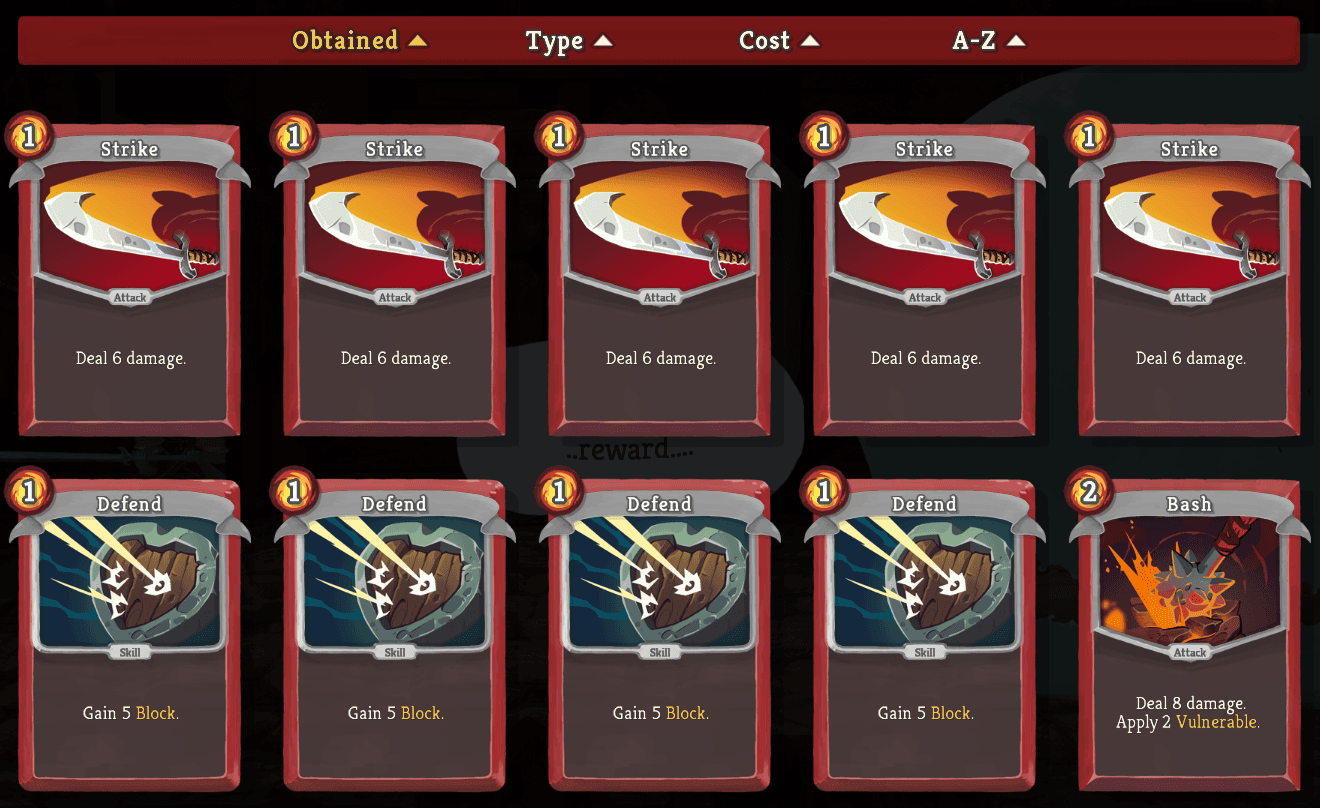
For simplicity, we’ll assume that clad draws 

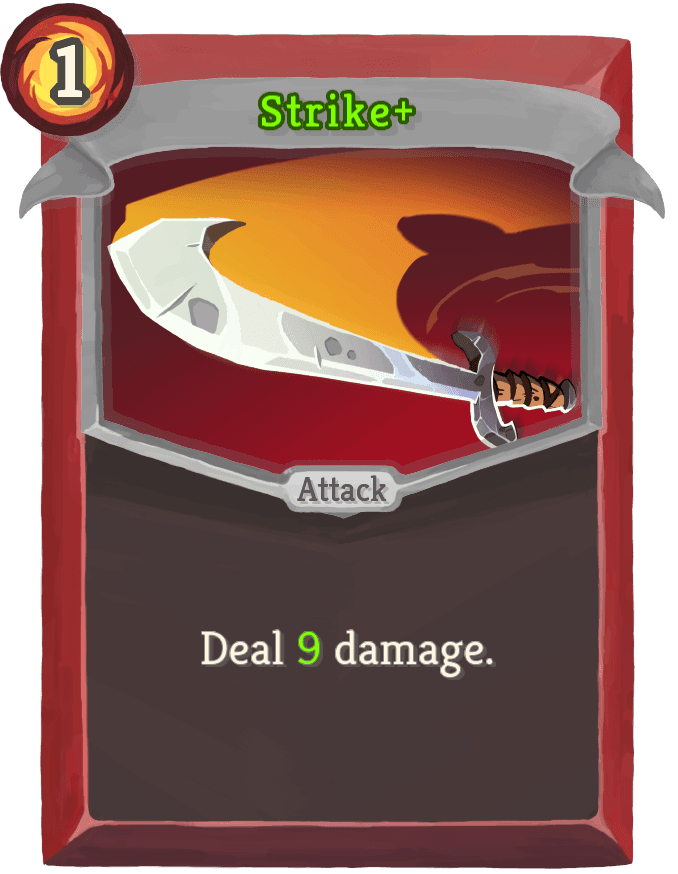
 Bash and one Strike on turn 1, three Strikes the next turn, and then repeats this pattern. The starter deck does 17 and 27 damage on alternating turns in this way - we can think of this as the Ironclad’s frontloaded damage. Ironclad can improve this frontloaded damage by upgrading a Strike (in this example, the one played alongside Bash). This adds 4 damage to the frontloaded output of the deck.
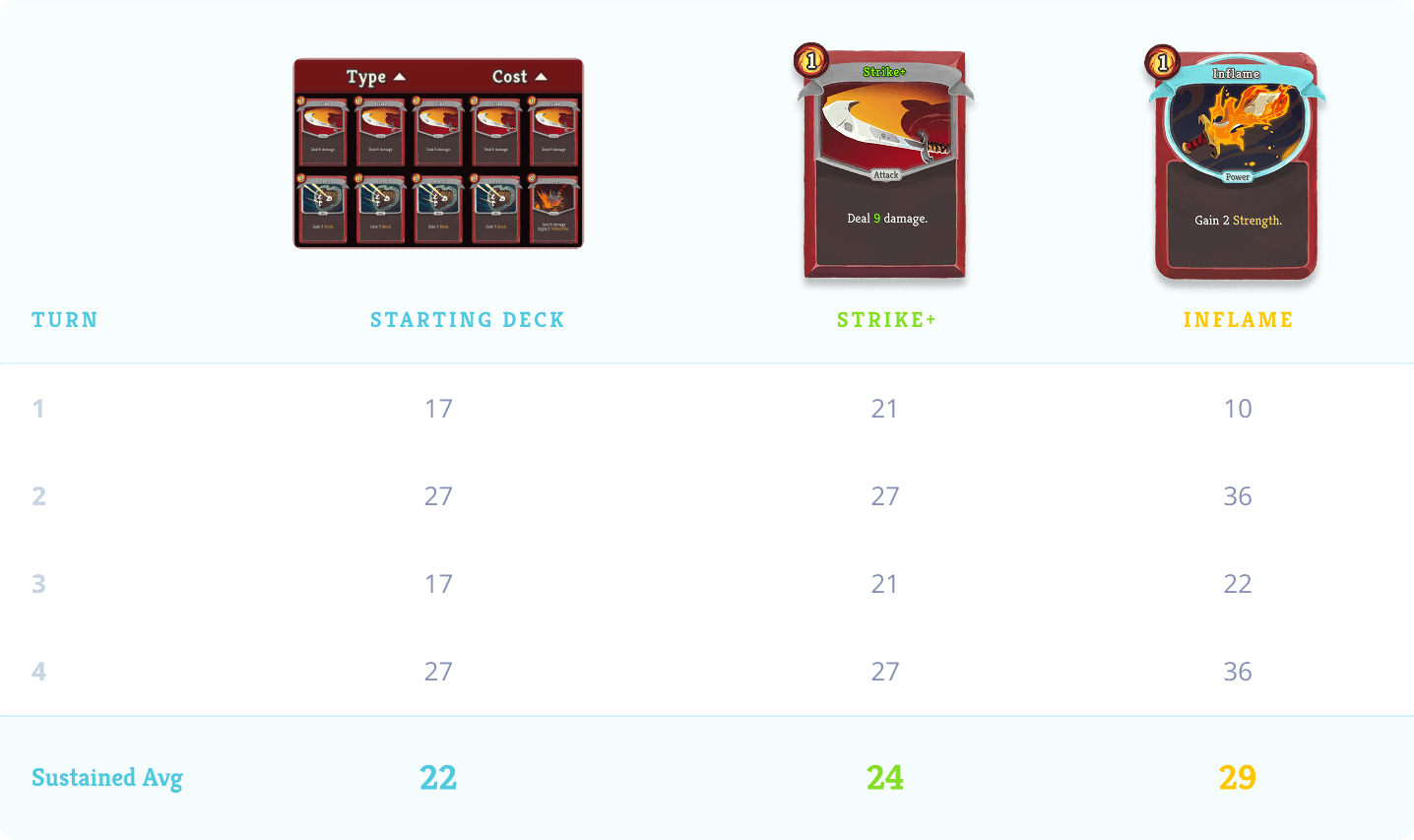
If more total damage is needed, then we want to instead add some scaling. 
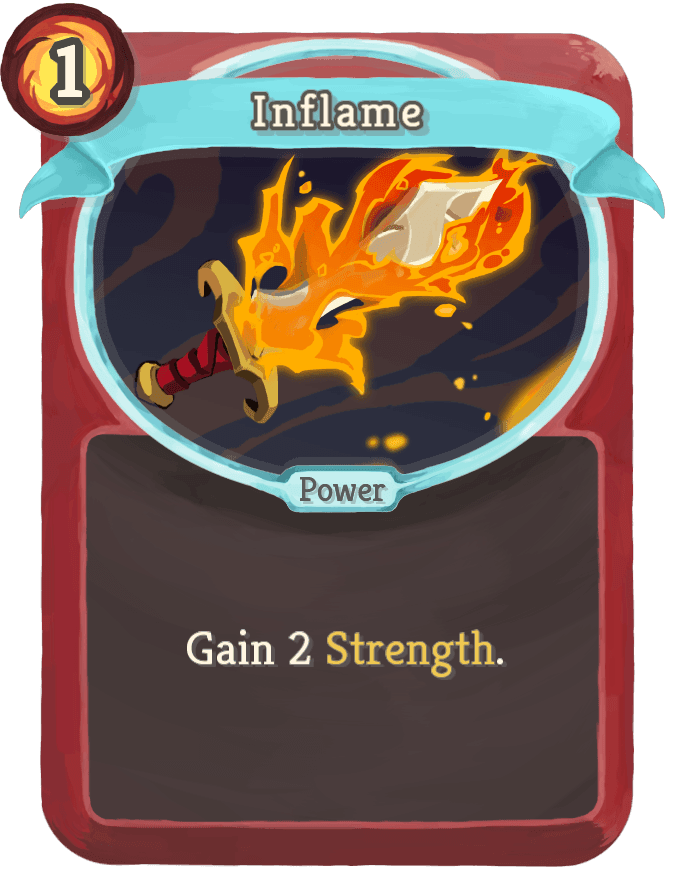
 Inflame is one of the simplest scaling cards for Ironclad, providing 2 points of strength that improves attack damage. By playing Inflame turn 1, Clad deals significantly more damage with his starting cards. However, spending energy on the Inflame means doing significantly less damage on turn 1. This highlights a core tradeoff of deckbuilding - to get scaling, you must sacrifice frontload.
 Cycle Time
Cycle Time - How many game turns it takes to draw all of the cards in your draw pile from the start of combat. You can get a good idea of your cycle time by counting the cards in your deck, subtracting the amount of card draw effects that you have and dividing that total by the number of cards you draw per turn (5 by default in StS2).
With the starting deck of 10 cards, that creates a cycle time of 2 turns. This means that by turn 2 at the latest, you have seen every card in your deck. This also tells you that you will see each card in the deck every 2 turns on average.
Note that an average is not a guarantee. Let us consider Ironclad’s starting deck of 5 Strike, 4  Defend, and Bash. Let’s look at how long it can take to re-draw Bash with some example hands.
Turn 1: Bash, Strike, Strike, Defend, Defend (5 cards remain in draw pile)
Turn 2: Strike, Strike, Strike, Defend, Defend (0 cards in draw pile)
Turn 3 (deck is reshuffled): Strike, Strike, Strike, Strike, Defend (5 cards in draw pile)
Turn 4: Bash, Strike, Defend, Defend, Defend.
With Bash drawn on turn 1 and turn 4, it took 3 turns for Bash to be re-drawn. At the same time, Bash was drawn twice across 4 turns - an average of once every 2 turns.
Your cycle time increases whenever you add a card to your deck, so each card must be carefully considered. Not every card is worth adding to your deck, so always consider whether you would like to skip.
Here are some ways to decrease (or keep low) the cycle time of your deck of cards:
- Remove cards at events or shops
- Add cards that draw 2 or more cards
- Upgrade existing cards to draw additional cards
- Skip instead of adding a new card to the deck
- Get Relics or Potions that can draw cards
Cards that draw only 1 card do not actually increase the cycle time of your deck compared to skipping.
For STS2, we can make an additional distinction between the cycle time of a deck’s first cycle and all subsequent cycles. This is because not all of your cards automatically go to the discard pile. Power cards attach to your character and cannot be played again, while cards with the Exhaust keyword are removed from play after one use. To approximate your re-draw time, take the number of cards in your deck (excluding any exhaust or power cards), subtract the amount of card draw effects you have, and divide by your cards drawn per turn. If a deck reaches a re-draw time of 0 turns, it can potentially achieve an infinite combo. Thus, minimizing the time it takes for your deck to re-draw can be a way to become strong.
Here's one of my run where Ironclad achieves a Pommel Strike/Sundial infinite using Exhaust to reduce Cycle Time, in a contained 24-card deck:
 Block Density
Block Density is a measure of what portion of your deck is dedicated to mitigating damage from enemies. This is expressed as the number of block cards in your deck divided by the total number of cards in your deck. A “block card” in this context is any card that reduces incoming enemy damage to you, even if it doesn’t directly generate block.
The Ironclad starts with a block density of 40% (4 defends / 10 cards). Most characters start with 40-50% density. The higher your block density, the more likely you are to draw one or more block cards on any given turn. Block density is therefore desirable so that you are more likely to be able to respond to enemy attacks. However, there is a problem. If block density is too high, then you are more likely to draw hands containing few or no non-block cards. Not every enemy will attack you every turn; some will apply debuffs or give themselves damage increases instead of directly attacking you. Taking advantage of these turns to deploy damage and power cards is essential to winning in Slay the Spire 2, so you also want to ensure that you are not left with only block cards in your hand.
I generally strive for a block density of about 33% for high-level play. Here are some statistical breakdowns to show you why. Let’s assume an example deck containing 30 cards that draws five cards per turn.
At 20% Block Density (6 block cards / 30 total cards)
- You have a 70.2% chance to get at least 1 block
- You have a 25.4% chance to get 2 or more blocks
- You have a 0.25% chance to draw 1 or 0 non-block cards
You’ll almost never be stuck with too many blocks, but you have almost a 30% chance to get none! This is probably too few block cards.
At 33% Block Density (10 block cards / 30 total cards)
- You have a 89.1% chance to get at least 1 block
- You have a 55.1% chance to get 2 or more blocks
- You have a 3.12% chance to draw 1 or 0 non-block cards
A higher block density gives much better odds to draw 1 or 2 blocks on an incoming damage turn, but still gives you low odds of having a full hand of block.
At 50% Block Density (15 block cards / 30 total cards)
- You have a 97.9% chance to get at least 1 block
- You have a 83.5% chance to get 2 or more blocks
- You have a 16.5% chance to draw 1 or 0 non-block cards
At this block density, you are extremely likely to have a block card in every hand. However you now have a significant chance of drawing a hand of entirely blocks, which can be devastating in the wrong situation. This might be too much block density.
You can improve your block density by adding cards that block or otherwise lower enemy damage such as adding the weak status, or by removing non-block cards. You can lower your block density if it’s too high by doing the opposite: removing unneeded blocks or adding new attack/power cards.
Not every run wants the same amount of block. Decks that consistently draw more than 5 cards per turn can get away with higher or lower block densities since having more cards in hand simultaneously increases your chance to have some block and decreases your chance to have only block.
 Upgrade Density
Upgrade Density is a similar term to block density, this time describing the portion of upgraded cards in your deck. Upgraded cards are usually better than unupgraded cards, so having more of them is a good way to measure how well your run is going. To determine your upgrade density, divide the total number of cards in your deck by the number of upgraded cards that you have. You start with an upgrade density of 0%.
You can improve your upgrade density in a few ways:
- Upgrade an unupgraded card at a rest site
- Remove an unupgraded card such as Strike
- Add a new upgraded card to the deck
Upgrading your existing cards is the best way to improve your upgrade density, but upgrades are limited during a run. Removing unupgraded cards makes you more likely to draw the upgraded cards that you already have and is your best bet for starter cards like Strike. Adding new upgraded cards is not available until Act 2 or 3 unless you have specific relics. Adding upgraded cards is generally quite desirable and should always be considered when one is offered. There’s not really an upper limit on how many upgraded cards one should add to their deck, though it’s important to keep cycle time and block density in mind.
Getting to 100% upgrade density is generally unrealistic except for the smallest of decks. I typically consider 33-50% to be a reasonable expectation for a winning run on high difficulty.

Baalorlord
A former chemistry instructor, Baalorlord is no stranger to teaching students the basics. He's been streaming on Twitch for more than half a decade, creating a cozy environment where you can learn how to smash games on the hardest difficulties. He also loves coming up with truly awful puns.