Bosses Intro Guide
Bosses in Slay the Spire 2 are terrifying foes that offer completely new challenges compared to the original game. Here's what encounters you can expect and how you can triumph against even the scariest of bosses.
Former collegiate Hearthstone player and current roguelike content creator Flare and his riveting PowerPoint form the cornerstone of this guide, which you can check out in full below for more details.
Act 1 (Underdocks) Bosses
Waterfall Giant
Starts combat by gaining Steam Eruption stacks (15/20). Each turn, it gains more, and when it dies, the accumulated Steam Eruption damage hits you after a one-turn delay. You can Block or Weaken to reduce the explosion.
The best strategy is to kill it fast so it doesn't accumulate too many stacks. Its regular attacks aren't especially threatening for an Act 1 boss, so trading HP to end the fight faster is often the right call.
Soul Fysh
Shuffles Beckon Status cards (which cost 1 Energy to play and if they're still in your hand at the end of the turn, you lose 6 HP, bypassing Block) and continues adding more throughout the fight. In an Act 1 deck, the density reaches critical mass fast.
The boss also gains Intangible for one turn in its cycle. Play Beckons early when the boss has less Strength, then go all-in once it's around half HP. Discard and Exhaust effects help manage Beckons. It also applies Vulnerable at the end of its attack cycle, making its next round hit significantly harder.
Lagavulin Matriarch
Starts combat with 12 Plating and sleeps for three turns or until its Block is broken. After waking, it cycles through attacks and then siphons 2 Strength and 2 Dexterity from you while gaining 2 Strength itself.
If it gets to siphon you twice, the fight is almost certainly lost: you'll be down 4 damage per Attack and 4 Block per defensive card. Poison and Orb-based damage are effective since they aren't affected by your Strength loss.
Act 1 (Overgrowth) Bosses
Ceremonial Beast
Starts with 252 HP and a Plow buff, with a stun threshold of 150. Until you break through it, the Beast attacks for 18(20) every turn and gains 2 Strength each time. Once the threshold is broken, it's stunned and loses all gained Strength, then shifts to a new cycle that includes Ringing (limits you to 1 card per turn).
You get two back-to-back free turns after the stun. The Ringing turns require high-value single-card plays like 

 Bludgeon or
  Sunder to stay efficient. After the Ringing turn, it attacks for 15(17), then 17(19) while gaining 3-4 Strength, so the fight can still scale out of control if you don't close it out.
The Kin
This fight involves three enemies: a Kin Priest and two Kin Followers. The Priest cycles through applying Frail, then Weak, then a triple-hit attack, then gaining 2-3 Strength. The left Follower starts by gaining Strength, and the right starts by attacking.
Kill the left Follower first since it's buffing and isn't attacking on turn one. AoE trivializes this fight. Even without it, the overall damage output is lower than most Act 1 bosses once you've eliminated one or two targets. The Kin Priest has less HP than other bosses, but the combined health pool across all three enemies is significant.
Vantom
Gains 9 Slippery at the start of combat, causing the next 9 instances of damage to deal only 1. Hard counters single big-hit strategies like Bludgeon. Multi-hit attacks, Shivs, Lightning Orbs, and Whirlwind are effective. Has lower HP than the Kin Priest.
Its big threat is a 27(30) damage attack that also shuffles 3 Wounds into your discard pile (even if you block the hit), followed by an off-turn where it gains 2 Strength. The cycle takes four turns overall, and its sharp tail helpfully extends forward towards you as it gets close to the big attack.
Debuffs like Weakness aren't blocked by Slippery. You may need to draft a multi-hit card specifically for this fight if possible.
Act 2 (Hive) Bosses
The Insatiable
A pure DPS check. Starts combat by applying 4 Sand Pit — when it hits 0, you die instantly. Sand Pit decreases by 1 each turn. Six Frantic Escape status cards are shuffled into your deck at the same time. Playing a Frantic Escape increases Sand Pit by 1 but costs 1 Energy (increasing by 1 each play).
Play Frantic Escapes early when the boss has less Strength, and the cost is still low - waiting risks them bottoming out in your draw pile. Slow, scaling decks are extremely vulnerable here. Its attack cycle isn't that threatening on its own, but the Sand Pit timer means you simply cannot afford a slow setup.
Knowledge Demon
Curses you at the end of each of its attack cycles (up to 3 times). You choose between two options each time.
First choice:
- Disintegration (take 6 damage at end of turn)
- Mind Rot (draw 1 fewer card).
Second choice:
- Disintegration stacking to 13 total
- Sloth (play max 3 cards per turn).
Third choice:
- Disintegration stacking to 21 total
- Waste Away (lose 1 Energy per turn).
The boss heals 30 HP and gains 2-3 Strength each cycle. Early Disintegration stacks are usually easier to absorb with Block than managing the restrictions. Slow decks suffer badly, as the accumulated Disintegration damage compounds with the boss's Strength scaling. Most runs should aim to kill it before the third curse.
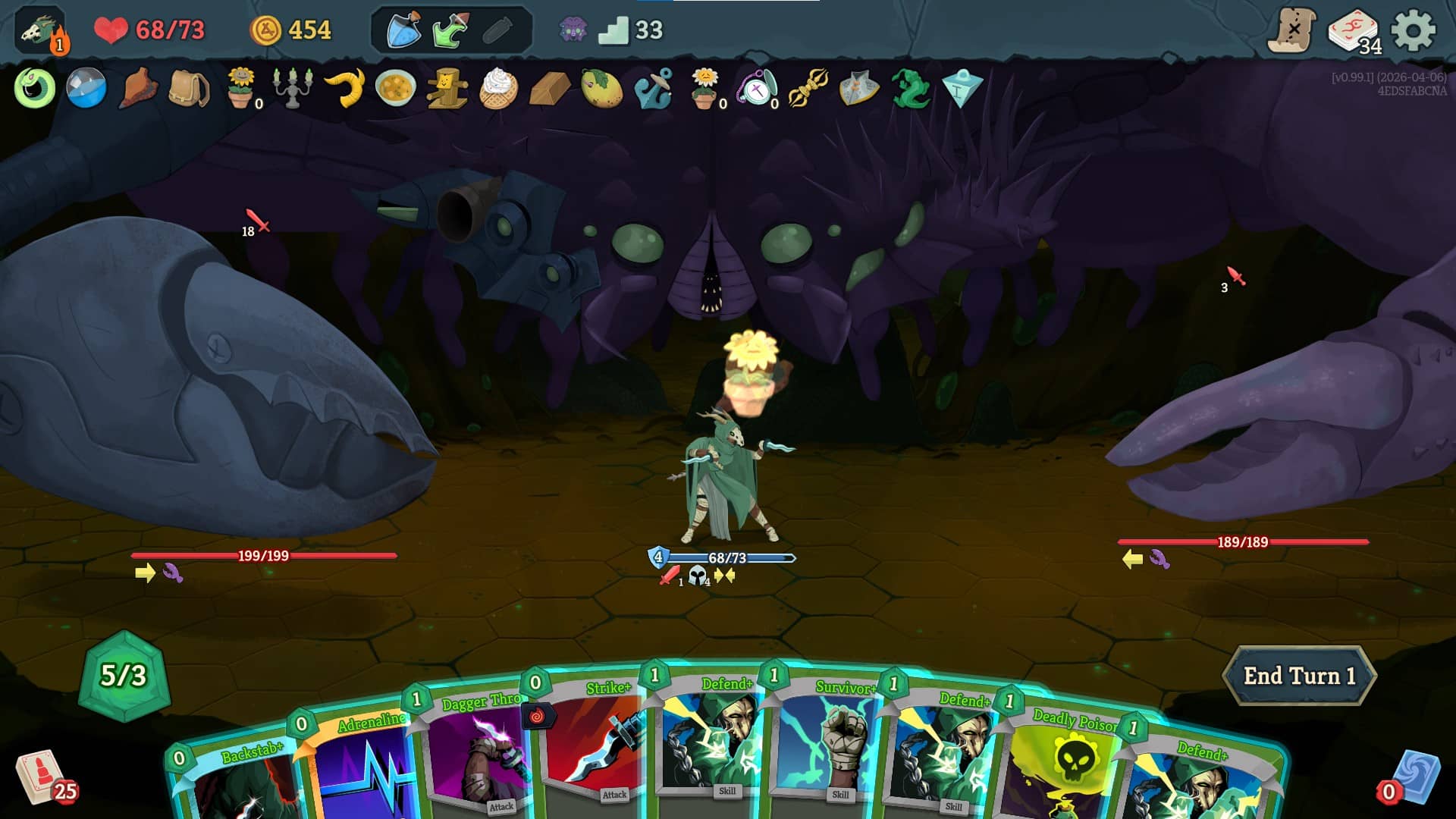
Kaiser Crab
Much like the Spire Shield and Spire Spear from Slay the Spire 1's penultimate fight, this is a split boss, with Crusher to the left, Rocket to the right, and there you are, stuck in the middle with them.
The logic of the fight is similar: Enemies attacking from behind deal 50% more damage. You face the one you are targeting with your latest attack.
Rocket has less HP and has an off-turn in its cycle where it sleeps for a turn (the same turn Crusher gains Block), making it the priority kill target. When one claw dies, the other gains 99 Block and 5 Strength for one turn, which is something you'll likely have to turtle up against. It is generally considered the easiest Act 2 boss.
Act 3 (Glory) Bosses
The Queen
Two targets: The Queen and the Torch Head Amalgam. The Queen starts by applying Chains of Binding (you can only play one of the first three cards drawn each turn), then applies 99 Frail, Weak, and Vulnerable. After that, she repeatedly gives +1 Strength to both herself and the Torch Head every turn and gains 20 Block per turn while the Amalgam is alive. When the Amalgam dies, the Queen shifts to her own attack cycle: deals 3-4 damage five times, then 15(18) damage, then gains 2 Strength
The Torch Head deals heavy, escalating damage on a cycle (18/19, then 18/19 again, then 8 damage three times, then two more attacks before looping back). You can either kill the Amalgam first to stop incoming damage, or burn down the Queen directly (Poison bypasses her Block). The Amalgam is a Minion, so killing the Queen causes it to flee.
The hardest Act 3 boss, and the fight is extremely decision-heavy. It requires strong card draw to work around Chains of Binding.
Test Subject
Another familiar foe that resembles the Awakened One, Test Subject has Three phases (100/200/300 HP). It is stunned for one turn between each phase, giving you free setup turns.
Phase 1 gains 2(3) Strength whenever you play a Skill (similar to Gremlin Nob in StS1). Phase 2 shuffles Wounds for each instance of unblocked damage. Its triple-hit attack increases by 1 damage each cycle, so full blocking matters. Phase 3 gains Intangible every other turn, has a 45-damage attack, and shuffles 3-5 Burns into your discard pile while gaining 2-3 Strength.
Scaling decks with Powers or sustained damage handle this well since you get multiple free setup turns across the phase transitions. Without scaling, Phase 3's Intangible makes it the hardest phase, as you're forced to alternate between turtling and bursting in a set rhythm.
Doormaker
The Door (155/165 HP) protects the Doormaker (489/512 HP) and must be killed first. The Door cycles attacks, gains 3-4 Strength, and keeps getting stronger. The Doormaker spawns stunned, then attacks twice (30/34 and 40/45 damage), gains 5 Strength, and revives the Door.
Crucially, debuffs persist on the Doormaker between appearances. Multi-hit attacks can bypass the Door. Ideally, you want to set the Door to single-digit HP, kill it with a cheap attack, then burst the Doormaker on the stun turn.
It is widely seen as the weakest Act 3 boss, and it was reworked in the v0.102.0 Beta Patch. The Grasp turn now attacks for 20(23) and adds a new power: "Whenever you play a card, lose 1 Energy," making the fight significantly more punishing on the turns where the Doormaker is active. At the time of writing, it remains to be seen whether that exact rework will make it to the main game.
Hungry for more Slay the Spire 2 knowledge? Be sure to check out our Getting Started guide!

This guide is by Flare, a former collegiate Hearthstone player, now roguelike content creator and a Slay the Spire 2 expert. You can check out his YouTube channel at https://www.youtube.com/@flareisgone